



Selecting the right technology stacks for your startup's SaaS product is a critical task during the startup planning phase. Your tech stack will provide the foundation and tools for developing your digital workspace and give you a competitive advantage by enabling scalable technology after your product is launched. In addition, selecting a tech stack that doesn't align with your product vision will increase your costs and delay your time to market.
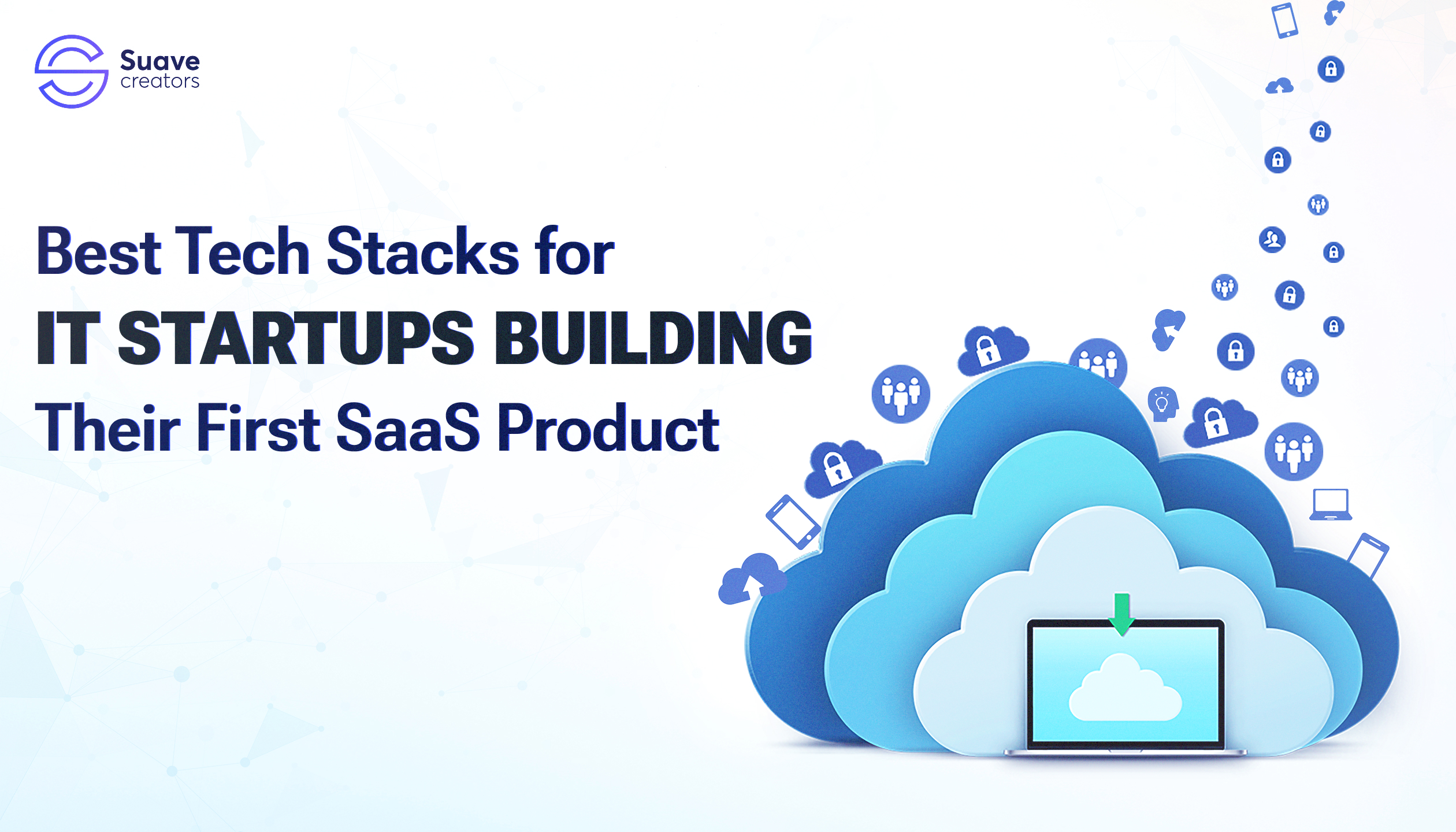
The best tech stacks for MVP development in SaaS startups offer the shortest time-to-market and the most experienced support from a wide variety of developers.
Phase 1: The Essential Components of a SaaS Stack
The SaaS application development services include different important elements, which all work jointly to bring the absolute user experience.
User Interface
HTML/CSS - HTML and CSS are what make up a typical webpage. HTML provides the layout of the page by describing how to build the framework (i.e., walls, rooms), while CSS adds the decorative aspects of that layout (i.e., paint and furniture).
JavaScript Frameworks - New JavaScript frameworks are being used by newer companies, and developers today to create fast and responsive websites. React is one such framework that provides a quick and easy build and organises different components of a webpage as reusable elements to expedite development.
The Backend (Think of This as the Brain)
This is where everything important happens behind the scenes. All the heavy lifting - logic, data crunching, security- it’s tucked away here, out of sight for users. The main programming options for a startup are:
Node.js (JavaScript): Node.js is extremely powerful when it comes to handling real-time user exchange with many concurrent users. The speed at which Node.js allows developers to create applications is greatly increased by using only one programming language (i.e. JavaScript) for both the front-end and back-end of a web application.
Python (Django): Django is another popular framework for developing web applications because of its clean and simple design and high-quality code. Django's vast collection of built-in security and administrative tools means that developers can save a significant amount of time building a minimum viable product (MVP) with Django.
The Database (The Memory)
This is where all your user data, settings, and business info live and are kept safe and sound.
PostgreSQL or MySQL (SQL): Think of these as super-organised spreadsheets. They use neat tables to keep everything in order, which really matters when you’re dealing with stuff like billing, user accounts, or financial transactions. Due to its reliability and extra tools, people trust PostgreSQL.
MongoDB (NoSQL): MongoDB is a unique NoSQL Database that doesn't utilise tables as its storage structure. Instead, it uses a more flexible storage structure in the form of documents. This allows a company to proceed rapidly, create a Minimum Viable Product, and be agile in their design. The storage structure does not restrict the design; thus, the design can evolve with time.
Phase 2: Top Full-Stack Recommendations
Startups usually go for a tech stack that balances speed, performance, and just feels good to work with. The following are the full-stack development for SaaS products:
The MERN Stack (JavaScript All the Way)
Developers love the MERN stack because it's all JavaScript. One reason is that having a shared language across the entire technology stack enables small teams to work quickly and easily transition between front-end and back-end development.
The MERN stack is ideal for building contemporary, scalable single-page applications (SPAs) with real-time functionality.
The Python/Django Stack (Simplicity and Security)
You’ll usually see this stack pairing a Python backend with a modern JavaScript frontend.
The Power: Django, for example, makes backend development surprisingly quick. Durango handles user authentication and database management. As a result, you get a solid, secure foundation for your startup.
The Use Case: Ideal for start-ups that employ sophisticated business processes. Start-ups that utilise elaborate business practices, such as content management systems and booking platforms.
Phase 3: Building a Scalable Cloud-Native Foundation
Scalable, cloud-native SaaS development is needed to enable a smooth user experience.
Cloud-Based Hosting
The first choice when hosting your application should be one of the big three public cloud providers - either Amazon Web Services, Google Cloud Platform or Microsoft Azure. Each of these providers is uniquely positioned as having the highest reliability and automatic scalability of your application. When you reach a tenfold increase in the number of users, your provider will automatically provide additional resources to handle the increased load without affecting your performance.
Docker and Container Technology
Transformational technology for deploying software today.
Docker containers bundle all aspects of an application together, e.g., code, dependencies, config files, etc.; therefore, creating a single lightweight, transportable file (a container). As a result, there are no longer any “it worked on my machine” situations, because the container will run identically on your computer as on the cloud server.
CI/CD Tools Enable Automation To Be Agile
Because of issue detection, teams cannot manually deploy each code change to ensure an agile development process. Automated Build/Job deployments are established so that once users commit their new code, the Automation Tool performs the following tasks without requiring involvement from a developer or IT administrator: Retrieve The Code From Version Control; Execute Tests; Build A Docker Image Of The New Build, And Upload The Resulting Container To The Cloud.
Conclusion
The MERN stack is the best technology for the First SaaS Solution, an IT Startup. The MERN stack has both the Speed today and the Power tomorrow by increasing the Developer Productivity today with a large Ecosystem surrounding the MERN stack. When MERN meets scalable services in the Cloud, such as AWS and Docker, it enables the fastest time-to-develop, test, and deploy a Minimum Viable Product (MVP) while supporting Massive Future Growth. By utilising Established Technology, Faster value can be provided to customers.
Suave Creators can build custom software for IT start-ups based on your brand identity, objectives, and target audience. Suave Creators utilises modern technology, clean design, and a results-oriented approach to provide you with web development services that improve your digital presence, user experience, and measurable growth of your business. You deserve excellence from your website, and we will provide it for you.