




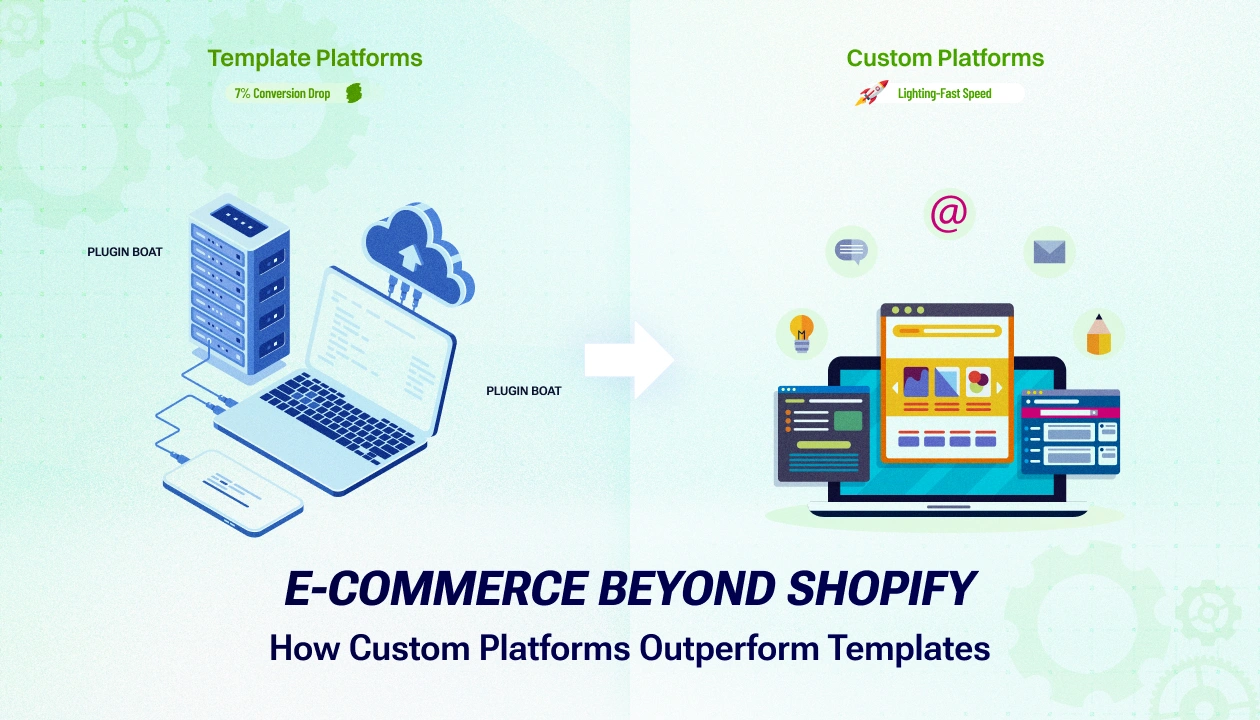
E-Commerce Beyond Shopify: How Custom Platforms Outperform Templates
Shopify changed the game. It made it possible for anyone with a product and a laptop to launch an online store in a weekend , no developer needed, no technical knowledge required. And for that, it deserves credit.
Shopify is great for getting started, but as your business grows, templates start holding you back. Custom e-commerce development gives you full control over speed, design, integrations, and the customer experience. In this post, we break down why established brands are moving beyond cookie-cutter storefronts and building platforms that are built to perform, built to scale, and built to convert.
But here's the thing nobody tells you when you're just getting started: the same features that make Shopify so easy to launch on are the exact features that will eventually hold you back.
Templates are built for everyone. And when you're trying to build a brand that stands out, "built for everyone" is the last thing you want.
The Template Ceiling Is Real , And Most Brands Hit It Eventually
In the early days of your store, a template is perfect. It's affordable, it's quick, and it gets you selling. But as your business grows, you start noticing the limits.
You want a checkout experience that feels like your brand , not a slightly customised version of what thousands of other stores are using. You want a loyalty programme that actually works the way your customers shop. You want your store to automatically sync with your warehouse, your accounts, your shipping system, without three different apps held together with hope.
And then you discover that your platform either can't do it, charges you extra to try, or requires workarounds that create more problems than they solve.
This is what's known as the scalability ceiling , the point where your platform stops enabling your growth and starts limiting it. In 2026, with online retail more competitive than ever, hitting that ceiling isn't just frustrating. It's expensive.
What Custom E-Commerce Development Actually Means
Custom e-commerce development means building your online store from the ground up , designed specifically around how your business works, what your customers need, and where you're planning to grow.
It's not about making something look different. It's about building something that works differently , faster, smarter, and entirely on your terms.
Here's what that looks like in practice.
1. Speed That Actually Makes a Difference to Your Revenue
You've experienced this yourself. You click a link, the page takes more than three seconds to load, and you're already gone before it finishes. Your customers do the exact same thing , and they don't come back.
Template-based stores carry a hidden weight. They're packed with generic code, unused scripts, and features built for every possible type of store, including all the ones that aren't yours. All of that extra baggage slows your site down, even if you never use any of it.
A custom-built e-commerce platform only contains what your store actually needs. Nothing extra. Nothing wasted. The result is a site that loads fast, performs well, and keeps shoppers on the page long enough to actually buy something.
Speed isn't a technical detail. It's a revenue driver. And it's one of the clearest areas where custom development pays for itself.
2. Personalisation That Goes Beyond "Recommended for You"
Every major retailer now shows personalised product recommendations. Customers have come to expect it. But there's a big difference between a basic plugin guessing what someone might like and a genuinely intelligent system built around how your specific customers actually behave.
With AI-powered e-commerce personalisation built into a custom platform, your store can analyse real behaviour in real time , not just what someone bought last time, but how they're browsing right now.
The result is a shopping experience that feels less like a store and more like a conversation. One that shows each visitor exactly what they're most likely to want, at exactly the right moment. That’s what turns first-time visitors into repeat customers.
3. Integrations That Actually Work Together
Your e-commerce store doesn't exist in isolation. It needs to connect with your warehouse, CRM, accounting software, shipping carriers, and payment gateways.
On a template platform, this usually means installing multiple third-party apps , each with its own cost and limitations.
Custom e-commerce development enables deep, direct integrations tailored to your workflow. Everything connects cleanly, runs automatically, and updates in real time across your entire system.
Your team spends less time fixing issues and more time focusing on growth.
4. A Brand Experience Nobody Can Copy
When you build on a template, you're sharing your foundation with thousands of other stores. Even after customization, the structure remains similar.
For brands competing on price, that might be fine. But for brands competing on experience, it becomes a limitation.
A custom-built storefront ensures your brand identity is reflected in every detail , from layout to interactions to user experience.
That level of uniqueness builds trust. And in e-commerce, trust is what drives conversions.
Is a Custom Platform Right for You Right Now?
If you're just starting out, a template platform is the right choice. It's fast, affordable, and helps you launch quickly.
But if you're growing, facing limitations, or relying on manual workarounds, that's a clear signal your platform is holding you back.
Moving to a custom e-commerce platform is an investment , but for businesses at the right stage, it delivers returns in performance, scalability, and customer experience.
Conclusion
Templates are a great starting point. Custom platforms are what serious e-commerce brands are built on.
The difference isn't just technical. It's the difference between fitting into someone else's system and building something designed entirely around your business.
If you're starting to feel the limits of your current platform, it may be time to explore what a custom solution can do.
Your platform should work as hard as you do. If it isn’t, it’s worth fixing.