





Enterprise software is the term given to large-scale, integrated applications developed to support or automate business processes that include CRM, ERP, SCM, and business intelligence, which run throughout the organisation. Enterprise software is designed to accommodate a large amount of data and its operations across a large organisation while improving efficiency and collaboration among the different departments.
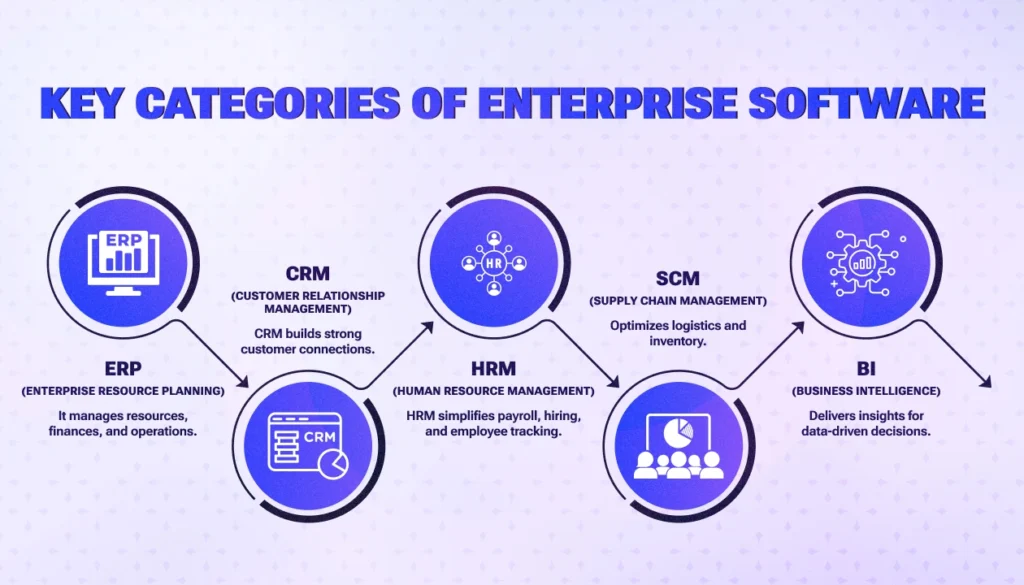
The main categories of enterprise software are:
Enterprise Resource Planning (ERP) that combines the important procedures of a business (e.g., finance, HR, and manufacturing) into one system.
Customer Relationship Management (CRM) to manage all interactions with potential customers.
Supply Chain Management (SCM) oversees the movement of goods and services from the supplier to the final deliverer in the supply chain.
Human Resource Management (HRM) includes all human resource management activities, including payroll, hiring, and performance management.
Business Intelligence (BI) analyse business data and provides actionable business insights to help with strategy creation.
The Power of Enterprise Software in Digital Transformation
Enterprise software (ES) is undeniably essential to modern organisations. It serves the function of connecting previously disconnected operational silos in a streamlined and effective way. More directed towards connecting operations to the second pillar of enterprise software, we turn to consider the persistent and well-known need for enterprise software to help organisations automate complex processes, manage/extensive data, and coordinate disparate business units across even geographic distance. Often, organisations look to enterprise software systems to scale operations, lower costs, and sustain competitive advantage in the marketplace. The second pillar of enterprise software consists of ongoing change in the market—new products or bundles of functionality become available every day in a rapidly changing world dominated by ongoing change. Consider the big movement to the cloud, with cloud-based (SaaS) options proliferating that offer enterprise software capabilities.
Primary Groups of Enterprise Software
For a better understanding, let's take a look at the main categories of enterprise systems.
Enterprise Resource Planning (ERP)
Enterprise Resource Planning (ERP) software is termed the "central nervous system" of an organisation. Often, organisations run their accounting and finance on one program, their HR on another, their factory floor on another, and their shipping on yet another solution. ERP systems combine these core functions (finance, human resources, and supply chain) into one centralised and integrated solution. The idea is to create a connection between departments and facilitate collaboration, while ultimately optimising the company's resources as a whole.
Customer Relationship Management (CRM)
A software solution for monitoring a business's relations with current and potential clients. It helps with the sales process automation, marketing campaigns, and tracking customer service requests. Lead management, sales pipeline tracking, customer support ticketing, and marketing automation are its functions.
Human Capital Management (HCM)/ Human Resource Management (HRM)
A Human capital management system has been developed to take care of the workforce. The HCM of today now includes more than just/human resources functions, now integrating talent management, workforce planning, and employee experience. This system manages all items related to your people, ranging from managing payroll, benefits, and hiring, to helping together their success.
Supply Chain Management (SCM)
SCM encompasses the general management of the journey of a product—that is, the whole flow of a product from raw materials to the finished product in the hands of the customer. Essentially, supply chain management manages every step, piece of information, and dollar spent in the whole flow of that process to ensure that it goes off smoothly without interruption or a lack of efficiency.
Business Intelligence (BI) and Analytics
Applications that analyse big data to reveal trends, patterns, and insights that can be viewed using various interactive dashboards and reports. Data visualisation, predictive modelling, reporting, and performance monitoring are some of its functions.
Collaborative Work Management (CWM) / Project Management (PM)
These are the tools that assist teams in remaining organised, monitoring who is doing what, and guaranteeing the completion of projects in a timely fashion. Its purpose is to assign tasks, manage timelines, assign resources, and communicate with the team.
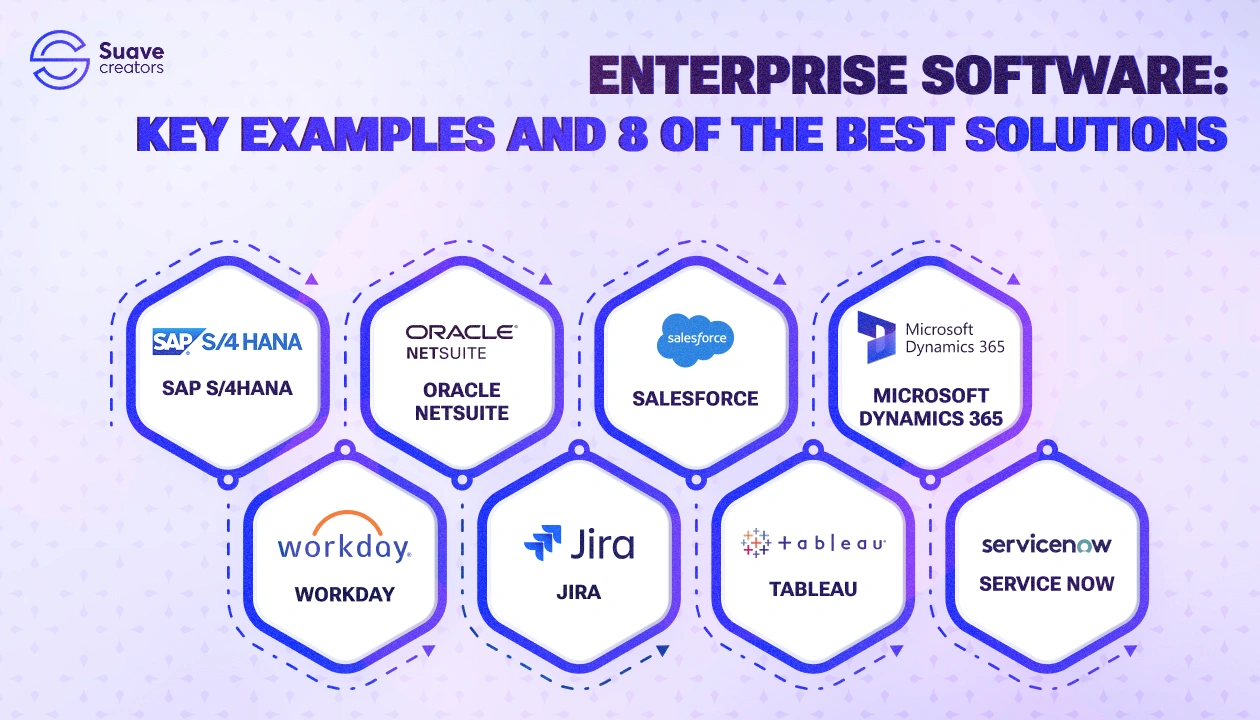
The Top 8 Enterprise Software Choices
The eight platforms listed below, which have been identified as best-in-class solutions, support many of the major features and capabilities necessary for larger companies to scale:
SAP S/4HANA is the ultra-speed engine of the enterprise world, an ERP system capable of performing complex transactions instantaneously.
Oracle NetSuite is the all-in-one cloud command centre to deliver a complete, scalable resource for everything from financials (ERP) to customer service (CRM) for businesses of all sizes.
Salesforce is the undisputed leader of customer relationships (CRM), a valuable and flexible platform that connects your sales, marketing, and service teams and can be adapted through an extensive library of apps.
Microsoft Dynamics 365 is the intelligent business suite that combines your finances (ERP) and customer interactions (CRM), and connects effortlessly to all the Microsoft tools your team uses daily.
Workday is the modern cloud leader for managing your most important assets, your money and your people (HCM/Financials). Workday is recognised for a simple, beautiful user experience in partnership with a large scope of future planning.
Jira (Atlassian) is the project manager of the digital age and the home base for agile teams who need to track bugs, manage backlogs, and keep complex software projects up to date.
Tableau is a simple translator for your data, getting rid of the serious numbers and spreadsheets used to turn data into easy-to-understand, beautiful visuals and simple stories for everyone in the company.
ServiceNow has some IT roots, but has become a digital flow expert capable of automating, managing, and creating workflows, from customer requests to internal services and processes.
Conclusion
Enterprise software goes beyond being a suite of applications - it enables digital capabilities. By connecting and linking core systems like ERP, CRM, and SCM on scalable, cloud-enabled platforms, enterprises will enjoy the real-time visibility and operational efficiencies necessary to thrive in an ever-increasing dynamic operating environment. The urgency and necessity for organisations to invest in best-of-breed applications such as SAP, Salesforce or Workday will change the future of your organisation: organisations will now have integrated data and automatic complex workflows to focus their energy on innovating, operating, and extending their business differential advantage.
Frequently Ask Question
Q1: How do ES and standard software differ?
ES manages and integrates all mission-critical aspects of an entire large organisation; whereas standard software is a standalone program that addresses one specific function for a smaller team.
Q2: Why is ERP the most important ES?
ERP provides one comprehensive source of real-time data for all core functions (finance, supply chain, etc.), and serves as the central nervous system of the organisation.
Q3: What is the primary function of the cloud in ES?
Cloud (SaaS) provides the foundational benefits of scale, flexibility, automatic updates, and a lower capital expenditure, therefore making it the preferred deployment.
Q4: How should organisations select an ES solution?
Choosing solutions is a process based on precise needs assessment that emphasises functional fit, scalability, and integration ability aligned with long-term strategic goals of the organisation