





The Internet is a huge, busy city, where each website or app is a building. For years, these buildings were standard. Then, a powerful tool called React came along. React allows developers to create small, self-contained pieces called components. Later, these small pieces can be arranged to build complex, beautiful interfaces like those you see on Facebook, Instagram, or Netflix.
React has revolutionised web pages and made them fast, smooth, and modern. This revolutionary tool has been mixed with Artificial Intelligence (AI). The combination of the speed and design power of React and the intelligence of AI is what is making web experiences smarter, faster, and incredibly personal for you. It's moving the web from a collection of standard tools to a helpful, personalised assistant.
How AI Boosts the Frontend Experience: Websites That Know You
When embedding AI into a React app, it not only adds intelligence to a passive display but also actively engages you while you're living your life.
Personalised Experiences: The Site That Reads Your Mind
One of the clearest and most enjoyable advantages of AI in the frontend is personalisation. It gives each user the impression that the app was designed for them.
Smart Recommendations: In the case of a shopping website using React, for example, AI, by looking at your browsing history, modifies the product components on the page, in real time, to show you the products that you are most likely to buy.
Dynamic Layouts: The layout of an app doesn’t have to be static. If the AI knows you always look for customer support first, it could automatically expand the “Help” component, or better yet, position it in a more visible area of the screen. Conversely, if a different user always looks for sales, the “Sale Banner” component could be front and centre at the top of the page. The site is literally changing its visual presentation based on who uses it, so every visit would result in a more productive and relevant experience.
Automation and Intelligence: Getting Things Done Without Lifting a Finger
AI will assume tasks that either take too long for the user to endure or that would require continuous, 24/7 attention.
Chatbot & Assistants: No more frustrations of navigating through a menu system to find a customer service number. Modern React web apps can seamlessly introduce advanced, sturdy AI-chatbot capabilities. Not only do they provide instant and seamless support within the React user interface, but they also work 24/7 without tiring out.
Anticipatory Actions: This is about saving you precious seconds. AI can also scan complex (and common) forms in many applications, and either pre-fill fields or flag potential errors (smart form validation) simply by recognising patterns in your answers, before you ever hit submit. It anticipates your needs, all in an effort to make the process as quick as possible and less error-prone.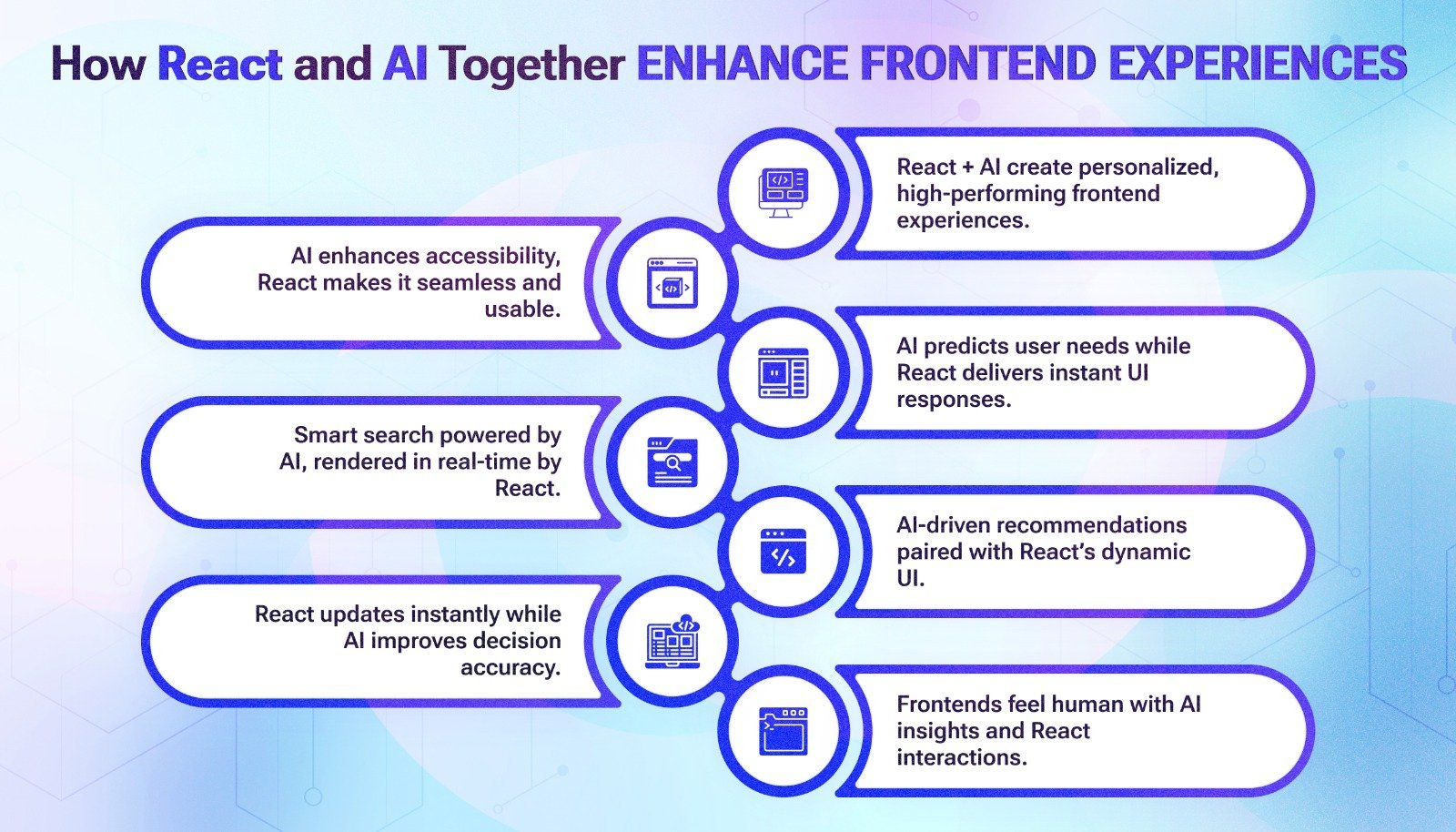
Faster Development: Making Developers Superheroes
AI serves as more than just a friendly assistant from the user's perspective; it is also an enhanced productivity tool for developers who create the applications.
Automatic code generation: Developers who engage in programming are also tasked with repeating the same sets of basic lines of code over and over again. AI-enabled tools can now take an inquiring developer's need for a component and immediately build the first code in React. This allows the programmer to skip the redundant, boring, lower-level tasks and jump right into the exciting and challenging creative classes of work that only humans can do! As a result, it actually enhances and speeds up the entire programming and development process.
Performance Help: As a React app grows, its codebase can become complex, sometimes leading to slower performance (what feels like “lag” to a user). AI can assess this complex code structure to identify the exact causes behind slow performance.
New Ways to Interact: Beyond the Click
With AI, applications can engage with the environment in numerous ways that extend far beyond the traditional keyboard and mouse.
Visual and voice input: TensorFlow.js and the many forks of it allow developers to execute smaller, simple machine learning models straight to the context of the user’s web browser, leveraging the React environment. This enables features where the app can identify images coming directly from your webcam (e.g. experiences where you “try on” glasses through the screen) or trigger functionality responding to spoken voice instead of clicking on a button (i.e. simply talking to the app). In either case, this provides a vastly richer, more intuitive, and probably more accessible experience for the user to engage with the website on their terms.
Conclusion
The combination of React's ability to create fast, reusable and beautiful user interfaces, with the flexible, predictive power of AI, is clearly the future of frontend development. We are being pushed in the direction of a web where every application is no longer a one-size-fits-all app - rather, it is an intelligent, context-aware, personalised assistant. This compelling combination results in greater user satisfaction because, finally, the web feels intuitive, and also results in faster development time as developers are enhanced by AI tools. Ultimately, React and AI together create the next generation of web experiences that feel like they are designed specifically for you.