





In this digital world, having a well-designed e-commerce website is not enough. You have to make sure that your online store is optimized to convert visitors into paying customers. The Laravel framework is popular because of its flexibility, security, and scalability, which help all businesses to create custom e-commerce solutions that are entirely functional, as well as high-converting e-commerce stores! With Laravel’s flexibility, you can tailor every aspect of your online shopping store to meet each business goal and deliver a smooth journey for your customers.
It doesn’t matter whether you run a small business, have a growing brand, or an enterprise that requires a digital ecosystem; this blog will provide you with insights on how to develop a scalable, secure, and conversion-focused e-commerce site with Laravel.
Why Choose Laravel for E-Commerce Site Development?
Among the most popular PHP framework options, Laravel is one for creating any modern web application. It has several benefits while developing e-commerce websites:
Scalability:- E-commerce websites regularly require an ability to endure growing traffic with the growth of the business. Laravel supports a strong base to build scalable e-commerce websites, which are capable of growing based on demand.
Security:- Laravel provides security from basic issues, such as SQL injection and cross-site scripting. Laravel also has an inbuilt authentication, which can protect your customers' data.
Customizability:- Laravel gives the ability for businesses to create a custom e-commerce solution based on their specific uses. Contrary to rigid platforms, Laravel allows for more extended flexibility.
Easier Integration:- Laravel aids in the integration of various components like payment gateways, inventory systems, or third-party APIs.
Performance:- Through Laravel's caching capabilities and query management, your site will be fast, which is especially important to be high-converting if you have an e-commerce site.
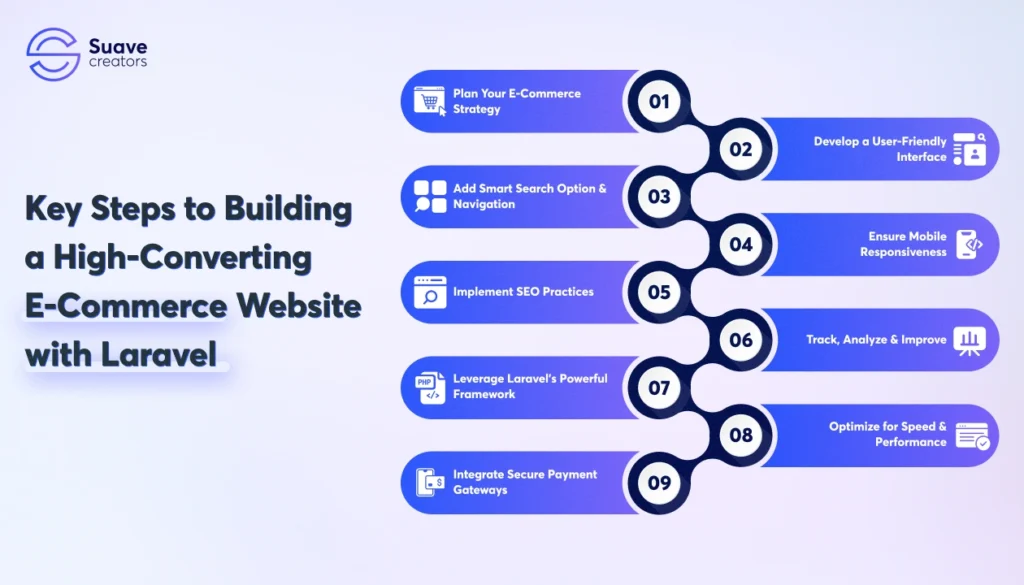
Guide to Develop a Successful E-Commerce Website Using Laravel
Develop your e-commerce strategy
Before jumping into development, ensure you outline important goals. Questions to answer include:
Who are your customers?
What are you selling?
How to make your site unique among the competitors?
A well-developed strategy can easily make Laravel-based websites customer-oriented and as well as tech-savvy.
Correctly select an appropriate tech stack that works with Laravel
Though Laravel serves as a base, you also need other technologies:
For front-end frameworks, there is Vue.js or React that can help build dynamic and engaging user interfaces.
For handling large catalogs of products, there are Database management systems like MySQL or PostgreSQL.
Redis is an example of Caching that can be used for faster page loads.
All of these technologies can provide seamless and scalable e-commerce websites.
Focus on User-Centric Design
A user-friendly e-commerce website is likely to be successful. With Laravel, you can build a:
Simple and built-in navigation so users can easily and effectively find products.
Receptive layouts that look approaching on mobile devices, tablets, and desktops.
Can develop customized experiences. About one-third of e-commerce customers want the features of a wishlist and/or a custom dashboard.
All forms of user-friendly designs reduce friction and increase conversion rates.
Use Secure and Simple Payment Gateways
Due to confusing or unsafe payment systems, e-commerce customers keep abandoning their carts. With Laravel, you can enjoy the most common payment gateways like Stripe, PayPal, or Razorpay. Make sure:
You have several payment options.
The checkout process is as easy as possible.
Security protocols like SSL and PCI are compliant.
An easy, safe checkout process is much needed for conversion.
SEO Optimization is mandatory from the very Beginning
Building your e-commerce website without SEO is like opening a store in the middle of nowhere! Laravel makes implementing SEO for e-commerce websites more effortless by:
Creating friendly URLs.
Providing meta titles, descriptions, and tags.
Implementing schema markup for the products page.
Creating fast loading speeds and mobile responsiveness.
SEO gives you organic traffic, which is, many times, the best-converting traffic for your e-commerce business.
Incorporate Smart Product Management Features
An e-commerce site needs to manage and handle inventory proportionately, variations of products, and categories. Building on the Laravel framework, you’ll be able to create:
Product catalogs that include crisp, quality photos with descriptions
Updating and developing filtering capabilities for size, or color, price, or brand, etc.
Manage stock automatically to track stocks in real time.
These elements contribute to establishing an easy shopping experience for your customers.
Optimize Load Speed and Overall Website Performance
A slow website is a killer for completing a conversion. Customers expect websites and pages to load when they are to load, within seconds (as a general rule of thumb). A successful Laravel implementation will allow you to optimize:
Route and query caching,
Optimize database queries for faster performance, and
Use Content Delivery Networks (CDN) to load information from a global scale much quickly.
Not only does a fast website provide a great user experience, but it also favors your SEO rankings.
Achieve Trust with Security Options
The basis for any successful e-commerce website is trust. A successful Laravel deployment will allow you to create trust with security options for your users and customers to enter their banking credentials.
If you’re going to create trust and do information gain used in part for personalization tools for the customer with personal conversations, your site needs to implement two-factor authentication.
If information is encrypted during the transaction process, these regular security updates to maintain your database, the trust will be lost.
Use Analytics to Increase Conversions
Now that your site is live with a Laravel e-commerce site, quarterly optimization is key to your shopping experience being successful. Getting started with tools like Google Analytics or integration of the Laravel Nova User Dashboard into your application to track significant metrics like:
Conversion rates.
Customer behavior.
Abandoned carts.
You will now be able to determine whether or not this sounds viable for further development.
Conclusion
Our team at Suave Creators believes that an e-commerce website should be more than a place to display products; it should convert visitors into long-term customers. Through our knowledge of Laravel e-commerce development, we create customized and scalable e-commerce websites that convert based on the latest technology.
While building your online store, our main focus is on design, payment integration, SEO, and performance architecture, so that we can provide you with something that will compete in today’s rapidly changing digital landscape.
If you are interested in a powerful, modern, high-converting solution that future-proofs your business, let the team at Suave Creators build it for you.
FAQ
1. Why should I use Laravel for building an e-commerce website?
Laravel framework offers scalable, robust security and a wide range of built-in features, making it ideal choice for creating a fast and customizable e-commerce solution.
2. How does Laravel help improve conversions on an e-commerce website?
With optimized performance, smooth checkout processes, and integration-friendly architecture, Laravel ensures a seamless user experience that boosts customer trust and increases sales.
3. Can Laravel integrate with third-party tools like payment gateways and CRMs?
Yes, Laravel supports easy integration with popular payment gateways, CRMs, and marketing tools, helping you streamline operations and improve customer engagement.