





Enterprise software (ES) is a collection of complex, sophisticated computer programs used to help an organisation manage the flow of data or a business function. It is typically used across multiple departments or locations. Whereas software focused on a person or small group is typically "nice to have," ES is one of an organisation's mission-critical, large-scale, enterprise-wide software that has increasingly complex data integration, process automation, and security capabilities. The ultimate importance of ES is to facilitate and improve overall efficiency, productivity, and data consistency across the organisation.
What is Enterprise Software?
Enterprise software (ES) describes applications and systems made for large companies that need to manage and integrate business processes that are critical to their operations. ES is intended to function across functional units, such as finance, human relations, supply chain, and operations, creating a standardisation of processes and a single source of truth in terms of organisational data. In short, ES is the backbone of an enterprise that allows a moderately large company to function, improve operations, and make data-based decisions.
Key Features of Enterprise Software
Scalability: Should be able to handle substantive volumes of transactions, users and data growth as the business grows.
Integration: The Function is to connect different functional areas and data sources to enable an integrated flow of information across the enterprise.
Centralised Data: Manages a single consistent database of core business data to avoid redundancy and data silos.
Business Process Management: Enforcement of standardised best practice procedures and workflows for commonly performed business tasks
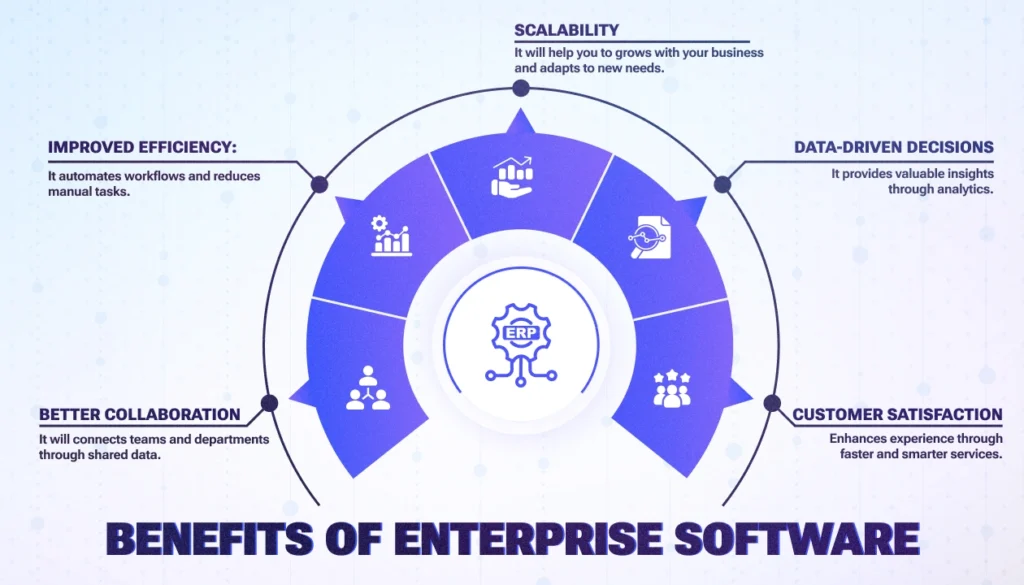
Advantages of Enterprise Software
1. Accelerated Operational Efficiency
A major motivation to utilise ES is to eliminate routine and time-consuming tasks through automation.
• Process Automation: ES allows workflows to be automated, ranging from invoice processing to inventory reordering and will lessen manual effort and human error considerably.
• Uniform Processes: Standardising processes on both the documented and process level will ensure consistency and predictability in all aspects of the ES, simplifying training and performance auditing for new team members.
• Giro Speed: The significant increase in cycle speed and automated processes (e.g. order to cash, procure to pay), will provide the business with the opportunity to respond to market demand much quicker.
2. Enhanced Data Management and Business Intelligence
Enterprise systems rely on a single, unified database that changes the way data is managed and obtained.
• Single Source of Truth - The premise of Single Source of Truth is one reliable source of information that tears down silos or barriers between silos within a department and fosters collaboration and better decision-making.
• Real-Time Reporting and Analytics: ES provides the capability to produce reports and dashboards in real-time, providing a live view of KPIs and the current operational status.
• Confidence in Decisions: High-quality, aggregate data enables executives and managers to spot trends and needs as well as make decisions based on hard facts, instead of guesswork.
3. Cost Savings
Although there might be a substantial first expenditure for ES, it can lead to substantial savings in the long run.
• Lower Administration Costs - The automation of data entry and data reconciliation means less administrative staff is required.
• Improved inventory and resource management - The use of ERP and SCM systems provides improved levels of forecasting accuracy, operational improvement in terms of inventory use, fewer stockouts, less overstocking, and decreased costs in storage.
• Regulatory Compliance and Audit Reliability - When compliance is embedded and data is reliable, there is more certainty of accurate regulatory reporting and internal audits, leading to fewer recommendations regarding material violations that could result in (and may result in) a fine (and substantial fines).
4. Enhanced Experience for Customers and Stakeholders
ES contributes directly to establishing a better relationship with customers, suppliers, and partners.
• Customer Relationship Manager (CRM): These types of systems consolidate the history of customers' interactions, and the customers' preferences and support tickets, facilitating a more personalised and consistent service to customers, thereby contributing to greater customer satisfaction and loyalty.
• Visibility Across the Ecosystem: New Supply Chain Management (SCM) systems will provide full visibility end-to-end, providing the enterprise the ability to communicate accurate order and delivery times to customers and partners.
• Quicker Service Delivery: Streamlining back-end processes will equal quicker service delivery and fill rates, providing an overall better service experience.
5. Improved Security and Governance
Enterprise systems have rigorous security measures and governance policies because of their mission-critical characteristics.
• Role-Based Access Control: Access to data is restricted based on the user's role in the organisation and the user's authority to access that data, thereby assuring the confidentiality of sensitive data.
• Audit Trails: Throughout enterprise systems, any change and any transaction that has occurred is logged, resulting in a complete audit trail for accountability and research.
• Regulatory Compliance: Many enterprise system modules are pre-configured to help organisations meet industry regulations and assist the organisation to remain compliant.
Various Examples of Enterprise Software
Enterprise Resource Planning (ERP)
ERP Systems are the most inclusive kind of ES. ERP systems combine all elements of an operation - product planning, product development, manufacturing, sales, marketing, and human resources to a unified whole, a single database and system. It acts as the central nervous system of the organisation. SAP S/4HANA, Oracle NetSuite, and Microsoft Dynamics 365 are some of the examples.
Customer Relationship Management (CRM)
CRM software manages relationships and interactions with potential customers. The purpose of the software is to enhance business relationships for the sake of sales growth. It supports sales pipelines, marketing campaigns, customer support and technical support. Salesforce, HubSpot, and Zoho CRM are some of the examples.
Supply Chain Management (SCM)
Supply Chain Management (SCM) is the management of the entire flow of goods, information, and cash. SCM confines the coordination and management of the activities involved in changing raw materials into end products and from the final product to the end consumer. SCM systems include: logistics, inventory management, demand planning, and warehouse management, to name a few. Oracle SCM Cloud, SAP Supply Chain Management, and Manhattan Associates are some of the examples.
Business Intelligence (BI) and Data Warehousing (DW)
BI is software that analyses business data to identify insights that promote action. DW refers to systems used to store data and manage aggregated data, which are consumed by BI tools. Visualisation of data, reporting, trend analysis, and practice prediction are its functions. Some examples are- Tableau, Microsoft Power BI, and Looker.
Human Capital Management (HCM)
Human Capital Management software is alternatively referenced as 'Human Resources Management Systems (HRMS).' HCM software provides management of the employee career lifecycle from hire to retirement. To assist with this process, HCMs typically oversee recruiting and onboarding, payroll, PTO administration, benefits administration, performance reviews, offboarding, and everything in between. Main functions are- payroll administration and benefits administration, employee record management, time and attendance, compliance manager, and training/learning management system. Some examples are- Workday, Oracle HCM Cloud, and ADP.
Conclusion
Enterprise software is not simply a suite of software programs; it is the central nervous system of integrated business processes in the digital era. Enterprise software connects finance, supply chain, customer relations, and human resources on one platform, enhancing efficiency, data quality, and strategic flexibility to their highest level yet. While implementation has challenges of cost and organisational transformation, the benefits: optimised workflows, cost savings, and real-time, data-driven decision making, lead to enterprise software being an obligation for any organisation that wants to scale effectively and remain competitive in the global market.